A new study shows that Kellogg Community College generates approximately $331 million annually for the local economy, an impact that is equal to 1.9% of the gross regional product of a service area that includes Barry, Branch, Calhoun and Eaton counties.
KCC’s operations, payroll, student spending and alumni spending each year combine to support 4,399 jobs, or one out of every 40 jobs in the four-county area, according to a new report by Lightcast, an economic data analysis firm.
“We’ve known that KCC impacts the lives of individual learners as they advance their careers and educational success,” said KCC President Dr. Paul Watson. “With this new data, now we know the measurable financial impact of our institution and our alumni, demonstrating how much the area economy relies on KCC’s continued success.”
The Lightcast report, which analyzes data from local, state and federal sources, also concludes that KCC is a reliable investment for students and taxpayers. KCC operates primarily on funding from local property taxes, state appropriations, grants and tuition revenue.
For students, KCC alumni receive a stream of higher future earnings that continues to grow throughout their working lives.
KCC associate degree graduates from 2023-24, for example, will see average annual earnings that are $9,400 higher than a person with only a high school diploma or equivalent working in Michigan. Over a working lifetime, this amounts to $376,000 more in total earnings. This represents an average annual return of 16.2% after attending KCC, where in-district tuition is currently $136.50 per credit hour.
Michigan taxpayers, who collectively provide KCC with $35 million annually through state and local taxes, benefit in several ways, resulting in a cumulative value of $1.30 returned for every dollar of public money invested in KCC.
As KCC students earn more, they make higher tax payments throughout their working lives. Students’ employers also make higher tax payments as they increase their output and purchases of goods and services. And because education is statistically correlated with a variety of lifestyle changes, KCC graduates generate savings in health care, the justice system and income assistance.
The social impact alone is hugely significant. KCC students are statistically less likely to add costs to consumers and systems because they will avoid medical costs associated with smoking, obesity, substance abuse and depression. They also will be more likely to remain employed and, therefore, less likely to require judicial activity and public assistance during their lives. Altogether, the social benefits of KCC represent a present value of $494.9 million. After factoring in the $67.2 million that it costs to fund KCC annually, this results in a return of $7.40 in benefits for every dollar invested in KCC.
“The results of the analysis demonstrate that KCC remains a strong investment for three major stakeholder groups: students, taxpayers and society,” Watson said. “Students receive a great return for their investment in an education from KCC while taxpayers’ investment returns more to government budgets and society’s investment creates a range of social benefits in Michigan and beyond.”
Data and assumptions used in the 2025 study, “The Economic Value of Kellogg Community College,” were based on several sources, including the fiscal year 2023-24 academic and financial reports from KCC, industry and employment data from the U.S. Bureau of Labor Statistics and U.S. Census Bureau, outputs of Lightcast’s Multi-Regional Social Accounting Matrix model, and a variety of studies and surveys relating education to social behavior. The study applies a conservative methodology and follows standard practice using only the most recognized indicators of economic impact and investment effectiveness.
For a full description of the data and approach used in the study, visit kellogg.edu/impact.
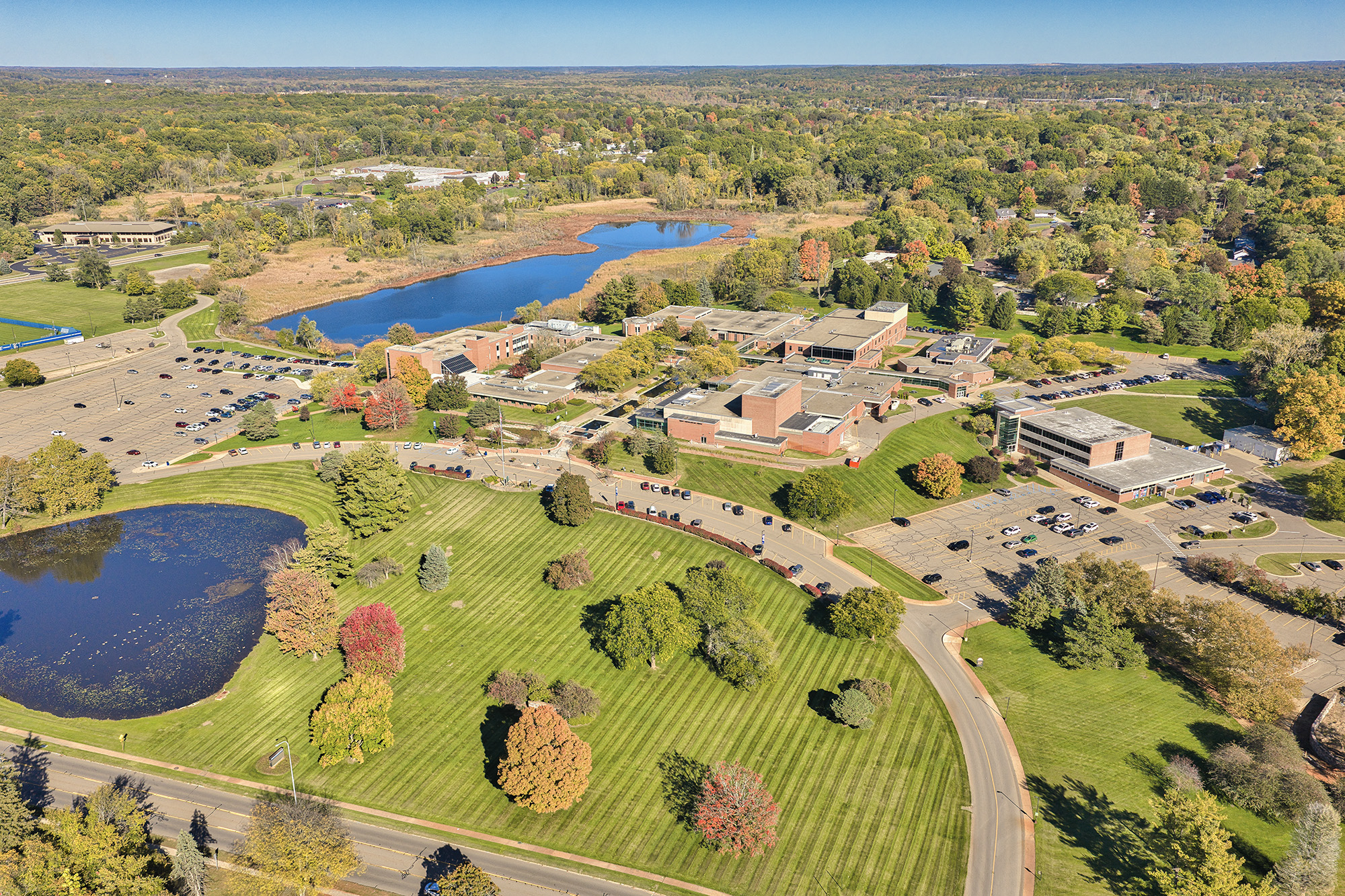
Photo by JJ Combs/Combs Drone Services.
A version of this news release first appeared in the December 2025 edition of BruIN magazine. To read the issue online, please visit kellogg.edu/bruinmagazine.
For more news about Kellogg Community College, view our latest press releases online at https://daily.kellogg.edu/category/news-releases.