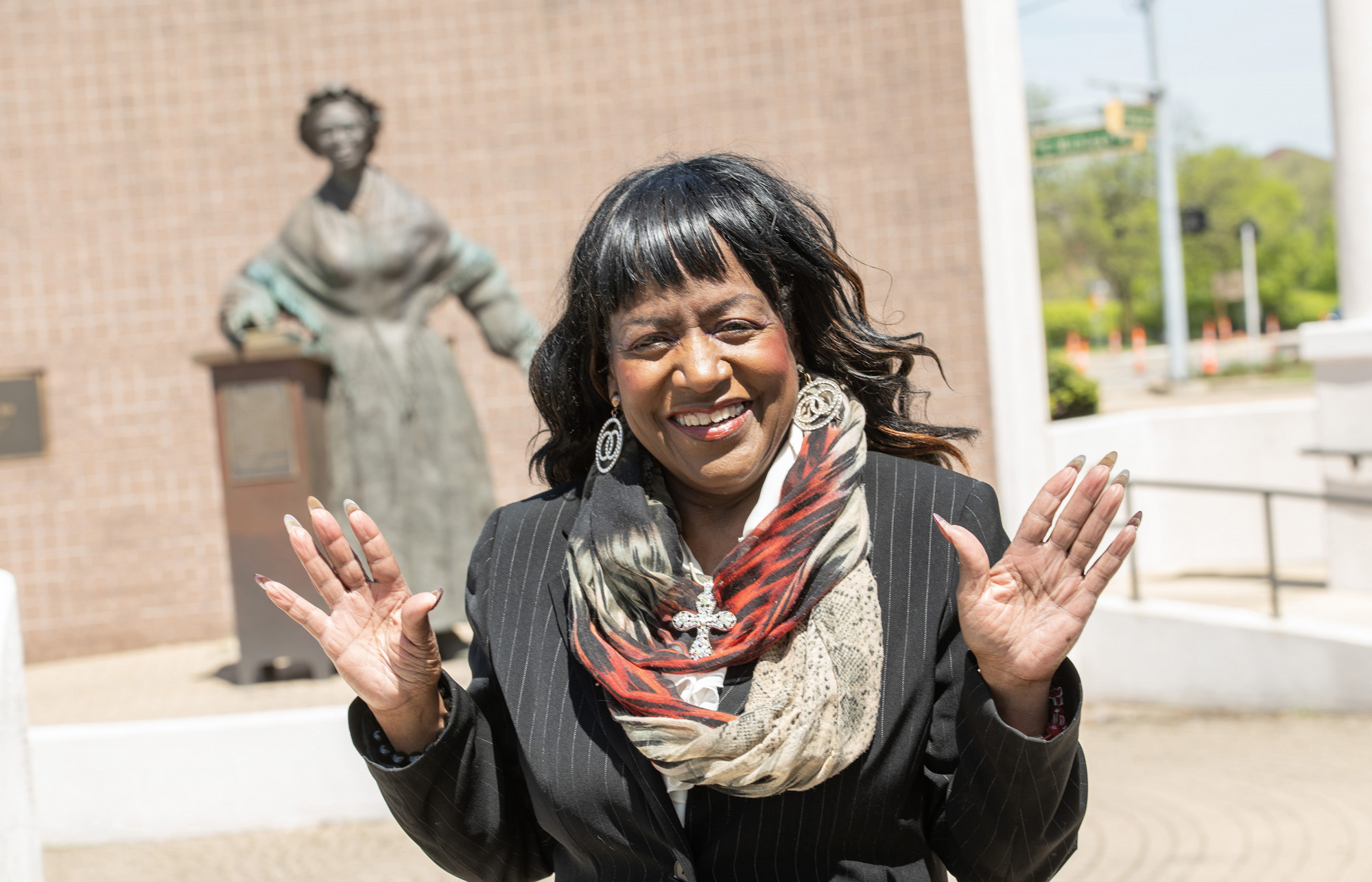
Donna Turner Rickman, of Olivet, graduated magna cum laude from KCC in 1988 with an Associate in Arts degree and went on to graduate with a teaching degree from Western Michigan University, continuing to take occasional classes at KCC for teaching recertification.
Now retired as a teacher – she taught for the Battle Creek and Lakeview public school districts – Rickman is an author of books for adults and children and has built a reputation as an expert on the life of Sojourner Truth, who she portrays onstage as a Sojourner Truth re-enactor and lecturer.
For her work educating the community about the life of Sojourner Truth, Rickman was awarded an Education: Educator State History Award from the Historical Society of Michigan in 2024, a prestigious honor that recognizes an individual dedicated to Michigan history and who teaches it to children and/or adults.
What first got you interested in the story of Sojourner Truth?
How I first got interested in the story of Sojourner Truth is twofold.
First in 1985, after moving to Battle Creek with my husband and children, I attended a luncheon sponsored by the Battle Creek National Association of Negro Business and Professional Women’s Clubs, whose national icon is Sojourner Truth.
At the end of the program I was approached by a member, Bertha Cheatham, who asked me if I would be interested in impersonating Ms. Truth by dressing up wearing a white scarf on my head, a white blouse, a long black skirt and boots.
It was then that I told her that I had never heard of Sojourner, having come from a rural town in Missouri, but was much interested in learning about her and what had made her so great; thus do some research to find out more!
I found out that as an adult, she was determined, somewhat fearless and guided by her Heavenly Father God but, more importantly, was born into slavery and was nationally known for her words, works and deeds as far as women and African American rights were concerned.
Secondly, I found out about the Historical Society of Battle Creek Archives and so ventured there finding the renowned and now late archivist and editor of publications, Mary Butler, who introduced me to the life and history of this great woman and her passions and work.
Soon after, I was asked to join another educator and Mary working on a historical curriculum of Ms. Truth entitled, “Truth’s Journey.” During that same time, I had come to realize my own love and passion for the words and works of Sojourner and thus, started re-enacting her in makeup and costume … even though I was much shorter than her in height and some people upon viewing me thought that I was Harriet Tubman.
Soon I was adjudicated via the Michigan Arts and Humanities Council and was placed into their touring directory for performances throughout Michigan.
What is a little-known fact about Sojourner Truth that more people should know?
A little-known fact or facts about Sojourner is that she was the very first African American woman – both as a slave and a freed slave – to win not just one but three court cases in her lifetime, as follows:
- With the help of her newfound Quaker family, who bought Isabella and her daughter’s freedom from Master Dumont, after walking from slavery with her baby, Sophia, and with the help of the Quakers and a newfound scribe, she was able to secure all rights back in court as a mother to her 5-year-old son, Peter, who had been illegally sold to an Alabama farmer and tortured and beat horridly.
- When Sojourner was living in New York in a religiously named commune, leaders falsely accused her of killing a man there with her being a live-in housekeeper, but she was acquitted and found not guilty.
- The third case was won after boarding and riding a streetcar in Washington, D.C., to work and help take care of the colored soldiers and their families at the Freedman’s facilities after being appointed by President Abraham Lincoln when she visited him at the White House. The conductor did not like her attitude about her sitting in the white’s only section versus not sitting in the “coloreds section” in front down by the horses. While standing he knocked her against the car panel, dislocating her shoulder. Riding with an abolitionist friend, Laura Haviland, she then recommended that Sojourner take it to Pullman’s board which recommended she take him to court, which she did and won the case. Thereafter, the inside of the streetcar looked like pepper and salt!
What part of her life seems to resonate most with audiences when you speak about her? Why?
The part of her life which seems to resonate the most with audiences when I speak about Ms. Truth I believe is the second rendition of the “Ain’t I a Woman” speech, which was written by Frances Dana Gage, who presided over the convention that day.
Quite ironically, Ms. Gage’s version was not even printed until 20 years later as she used quite a bit of Sojourner Truth’s words as well as her own colloquial and racially charged words to try and sway many women’s thoughts about what had actually been stated and interpreted by the audience back in 1851.
According to Sojourner’s version, her words had been hand-recorded by Marius Robinson, a friend and African American businessman who owned and operated the Anti-Slavery Bugle newspaper. Both he and his wife were friends of Sojourner who had invited her to stay in their home during the convention in Akron, Ohio, in 1851.
For some reason, many readers believe Ms. Gage’s version over Mr. Robinson’s hand-written account to be most authentic … even still today!
If Sojourner Truth were alive today, what message do you think she would emphasize most?
If Sojourner Truth were alive today, I believe the message she would emphasize most is for all people to become prosperous and self-sufficient by leaning on God’s words and His promises!
How? By becoming educated through the reading of the Bible and book learning to learn and earn financial security, freedom of all one’s rights according to the Constitution, and have the stamina and insight to provide for one’s family – inclusive of owning one’s home and own mode of transportation, as she owned four homes herself as a single woman.
In the end, such steps she believed should be passed on and down through the generations in their abundance of knowledge, family ancestry, wealth and security, the right to liberty and to vote, as she tried several times but was denied such opportunities in casting her ballets.
Please remember that Ms. Truth could neither read nor write, however depended upon fellow Quakers and friends such as William Lloyd Garrison, Frederick Douglass, Harriet Beecher Stowe, Francis Walling Titus (Sojourner’s scribe after her grandson Sammy died) and various other abolitionists and suffragists to get her where she needed to go, provide shelter during her travels and/or speaking engagements, and be able to make such a difference in so many people’s lives … even today!
What do you think is the most important thing to remember about her legacy?
What I believe is the most important thing to remember about Ms. Truth’s legacy is that she was born circa 1797 and died in 1883 in Battle Creek and is buried in Oak Hill Cemetery. She told her family and friend, Frances Walling Titus, upon her deathbed that, “she was not going to die but was going home … like a shooting star!”
After being invited to speak at the Friends of Human Progress Committee (Quakers) meeting during the weekend of November 4 and 5, 1856, she then sold her house in North Hampton, Massachusetts, and moved to Michigan to purchase several properties and live in Harmonia.
Ten years later she moved into her Battle Creek home, thus becoming the first citizen of any race or gender to bring national acclaim to the town!
And what she brought through her most revealing thoughts, powerful words, undeniable courage and remarkable actions that could move mountains, with courage was to speak God’s truth and change the world. She left a legacy of being one of, if not the most, highly celebrated and respected women not only in American history but infinity.
From slave, abolitionist, preacher, suffragist, temperance leader, orator and freedom fighter for justice, she summed it all up below:
“Lord, I have done my duty and I have told the truth and kept nothing back.”
Anything else you’d like to say?
I have felt so honored and blessed to have researched, studied, learned and taught myself about the life of Sojourner Truth, thus having re-enacted, performed and written more than six lectures about her life … and I am still learning!
For more information about Donna Rickman, visit simplydonna.org.
A version of this Q&A will appear in the June 2026 edition of BruIN magazine. To read the issue online when published mid to late June, please visit kellogg.edu/bruinmagazine.