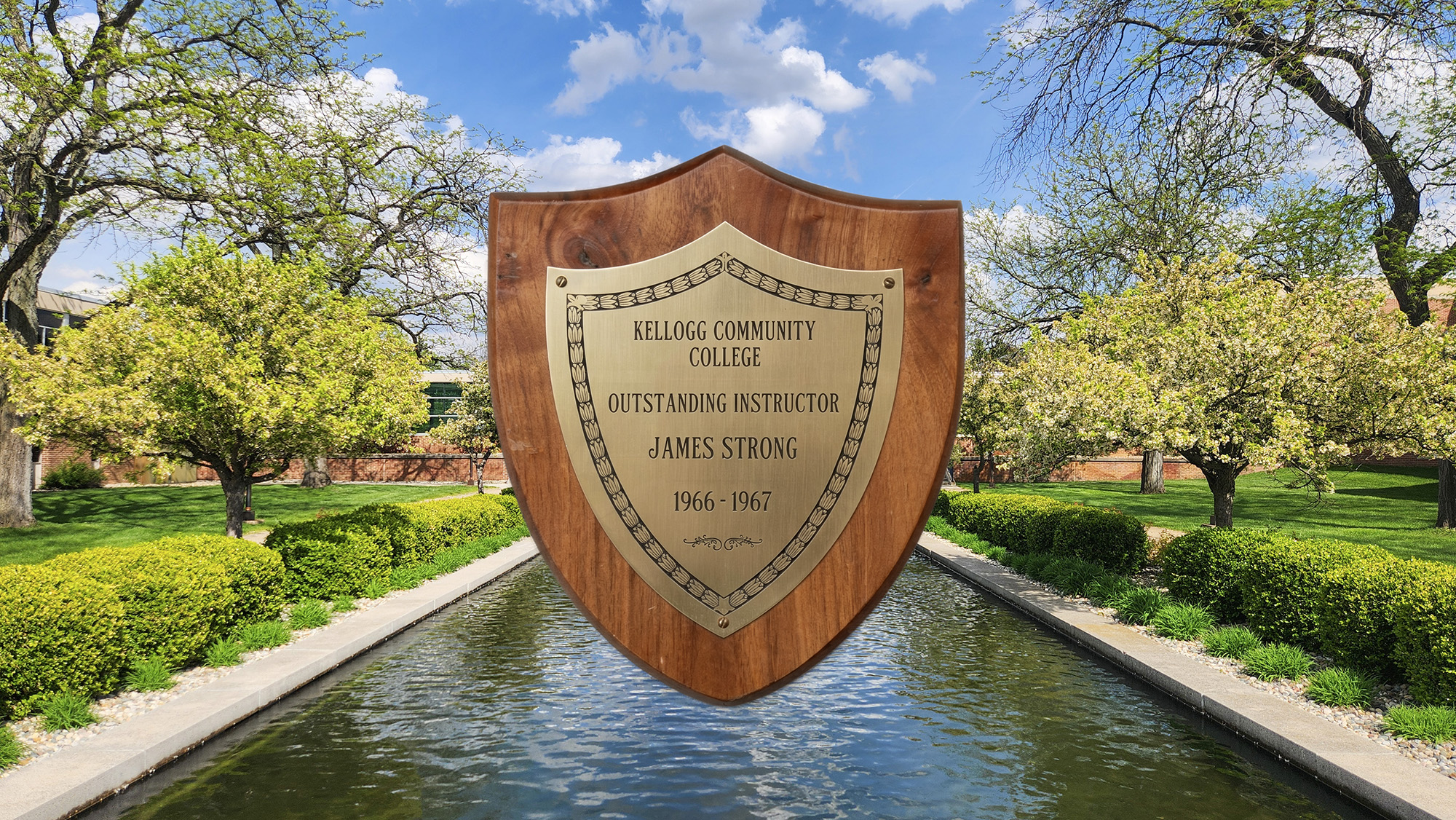
James “Jim” Strong is a retired science professor currently living in Washington state. Strong was faculty at Kellogg Community College starting 1966 and continues to support KCC through an established scholarship at the KCC Foundation.
Early Life and the Path to College
Tell us about your background and where you grew up.
I was born in Memphis, Tennessee, on Nov. 26, 1938. During the Depression only one member of a household could have a job. My mother had been a schoolteacher in the Shelby County schools. At that time two years of education beyond high school could get you in front of a classroom for the queenly sum of $1,200 per year. My father was colorblind and flatfooted, so when WWII came, the services did not want him. In a strange set of circumstances, he was out of a job and spent the war years building wooden toys in the garage. The most critical experience of those early years was watching Mom and Dad support the family with lots of sawdust and brilliant, meaningful help from several Afro-American people. My older brother (now 93) and I agree that we never heard a racial slur at the kitchen table or anywhere else within the immediate family. The “help” came and went as we did. My dad died in 1956 shortly after I graduated from high school.
What led you into teaching?
I attended college in Memphis (Southwestern at Memphis), graduating in 1960. This was followed by three years in the US Navy, and that followed by graduate school at UT Knoxville. I received an MS in Analytical Chemistry. As a graduate assistant at UT, I “taught” recitation sessions and presided over labs. It was there that I literally fell in love with teaching. It was that and my miserable experience as an undergraduate listening to pedantic, boring, lectures that kickstarted my “no one gets bored or goes to sleep” approach to the classroom.
How did you first learn about KCC?
As I recall, the opening at KCC was listed in the Chronicle of Higher Education. I do not remember anything about the interview but was delighted to join the faculty beginning in Fall 1966.
What attracted you to join the faculty?
The faculty was friendly, helpful and delightful to work with. We made friends almost overnight and the friendships reached beyond the teaching day. Sid DeBoer was Science Department chair and Earl Coy was head of chemistry.
What was the College like when you arrived?
The College was busy and growing with the faculty numbering above 100 full-time individuals. As I recall, friendships developed across the whole of the faculty. My best friend was a biologist named Charley Thaxton. We lived in the same very small town of Colon and usually commuted together.
The Early Years of the Institution
What were the biggest challenges facing the institution at that time?
In my first year the faculty was very restive and as a whole moved to join the AFT (American Federation of Teachers) as bargaining agent. After some perilous, negative conversations, the faculty voted to go out on strike before the beginning of the 1967-68 year. As a stubborn Tennessean with a wife and new child I went to work. Surprisingly, it was never thrown up against me by anyone.
What traditions or practices from those years stand out to you?
I honestly do not recall traditions or practices beyond having good friends from across the faculty and great mentors.
Teaching and Students
What subjects did you teach?
During my two years I taught science majors, chemistry exclusively, lectures and labs.
What was your teaching philosophy?
My first principle for teaching is that No One Gets Bored or Goes to Sleep. We pushed the students hard so they would be prepared for what we knew would be expected of them in the transfer/senior institutions. Here and everywhere else in my career, the operative title is COLLEGE.
Do any students or student stories particularly stand out?
There is one positive and one negative story I would like to relate. Positive: At the end of my first year, I reached out to information in a new book back then, called “The Territorial Imperative.” I used it to show the students that there was more ahead for them across all fields and that pedantic regurgitation of facts was not education … learning to think outside the box was. I was rewarded with a standing ovation. The negative story was that in 1968 in my hometown of Memphis, Martin Luther King Jr. was assassinated while I was lecturing. There were several excellent Afro-American students in my class, and I could think of nothing to say more than “I am sorry.”
What did you hope your students would take away from your classes?
I hoped that my students would know that I and they had given it our all, and that they were ready for what lay ahead of them.
What was the most rewarding part of teaching?
Year after year, regardless of where, I found joy in watching my students learn, mature and succeed. If they simply could not or would not “get it” it never detracted from their value as human beings or positive, productive people.
Personal Reflections
Looking back, what are you most proud of?
Over the years I had only very few students (one unbelievably) to say I was unfair. They may have thought it but did not say it.
What impact do you hope your teaching has on students?
Confidence in their abilities.
What did the college contribute to your own life?
Teaching was and still is especially important as a positive contribution I can make. Yes, I am still making presentations, even to people in my age bracket.
Scholarship and Donor Story
What inspired you to establish your scholarship?
At my last college I always did a survey of students as to their academic plans and, as an aside, their job stresses. Eighty percent indicated that they worked at least one part-time job to make ends meet.
Why was supporting students through a scholarship important to you?
Over the years I have seen so many students being harried by financial worries. I wanted to make their lives a little easier.
What do you hope scholarship recipients gain from their education?
I hope they see their way forward to what they want their lives to be.
What message would you share with future scholarship recipients?
You’ve got it … go for it.
Legacy and Future
What advice would you offer to current students?
Put away your phones and learn to communicate eye to eye. Olde fashioned I am eh whot?
What advice would you offer to current faculty?
Patience and give them the ability to communicate without the phones. I honestly am thankful I am no longer in a formal classroom with the telephone mania, AI and all the rest. It would make evaluation a nightmare.
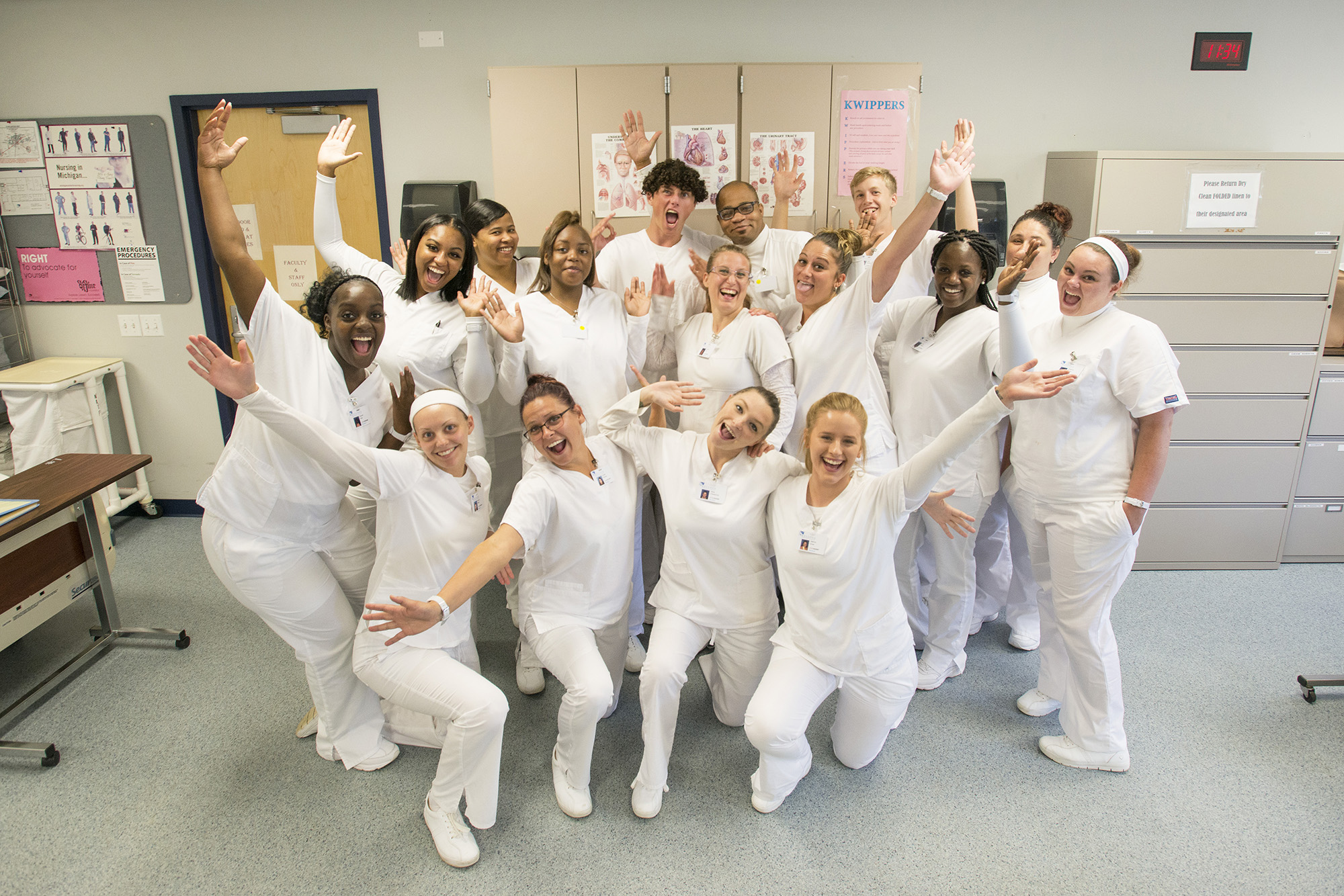
The James M. Strong Scholarship supports students pursuing an Associate in Science or Associate in Applied Science in Nursing degree, covering tuition, fees, books, supplies and uniform costs. For more information, contact the KCC Foundation at 269-965-4161 or kccfoundation@kellogg.edu.
This article first appeared in the September 2026 edition of BruIN magazine. To read the issue online, please visit kellogg.edu/bruinmagazine.