By Dr. Ray DeBruler
Guest Writer
Born in New York around 1797, Isabella Bomefree escaped from bondage in 1826 and “sojourned” around the country speaking the “truth” about the evils of slavery. By 1843, she was calling herself “Sojourner Truth.”
Truth personified three significant social movements of the mid-19th century: She advocated for a woman’s right to vote, the abolition of slavery, and prison reform. In her mind, they were linked. Later in life, Truth also spoke out against capital punishment.
In 1850, the abolitionist editor William Lloyd Garrison published Truth’s memoir, “The Narrative of Sojourner Truth: A Northern Slave.” She had dictated the memoir to Olive Gilbert, a friend, because Truth never learned to read or write (there is extant an autograph book with her signature, the only known example of something she wrote). And English was not her native language. She grew up speaking Dutch, like so many New Yorkers did at the time.
Truth moved to the Battle Creek area in the late 1850s and continued her advocacy work. She lived in the Harmonia utopian community whose members practiced Spiritualism. It was during this time she traveled to Ohio and gave the famous “Ain’t I a Woman?” speech, although she never uttered those words.
Truth visited with U.S. soldiers during the Civil War, particularly the men of the 1st Michigan Colored Infantry, many of whom were from Battle Creek. During the war, Truth worked with escaped slaves in Washington, D.C., at the Freedman’s Village. She discovered that southerners were kidnapping Black children from the village to return them to slavery. Truth spoke out against that practice and fought for parental rights. She also visited Abraham Lincoln to discuss, among other things, desegregation.
Despite her abolitionist work, Truth was never part of the Underground Railroad, which had a station in Battle Creek. After the Civil War, Truth returned to Battle Creek to continue her advocacy for women and Black Americans, sometimes by startling methods. For example, she tried to vote in the 1872 election.
Sojourner Truth died in 1883. She worked and lived long and hard enough to see the end of slavery, but her other passions (women’s rights, prison reform and the abolition of capital punishment) would be left to the next generation. Future reformers would tackle those issues with varying degrees of success, but always building on Sojourner Truth’s legacy. Her final resting place is at Oak Hill Cemetery in Battle Creek.
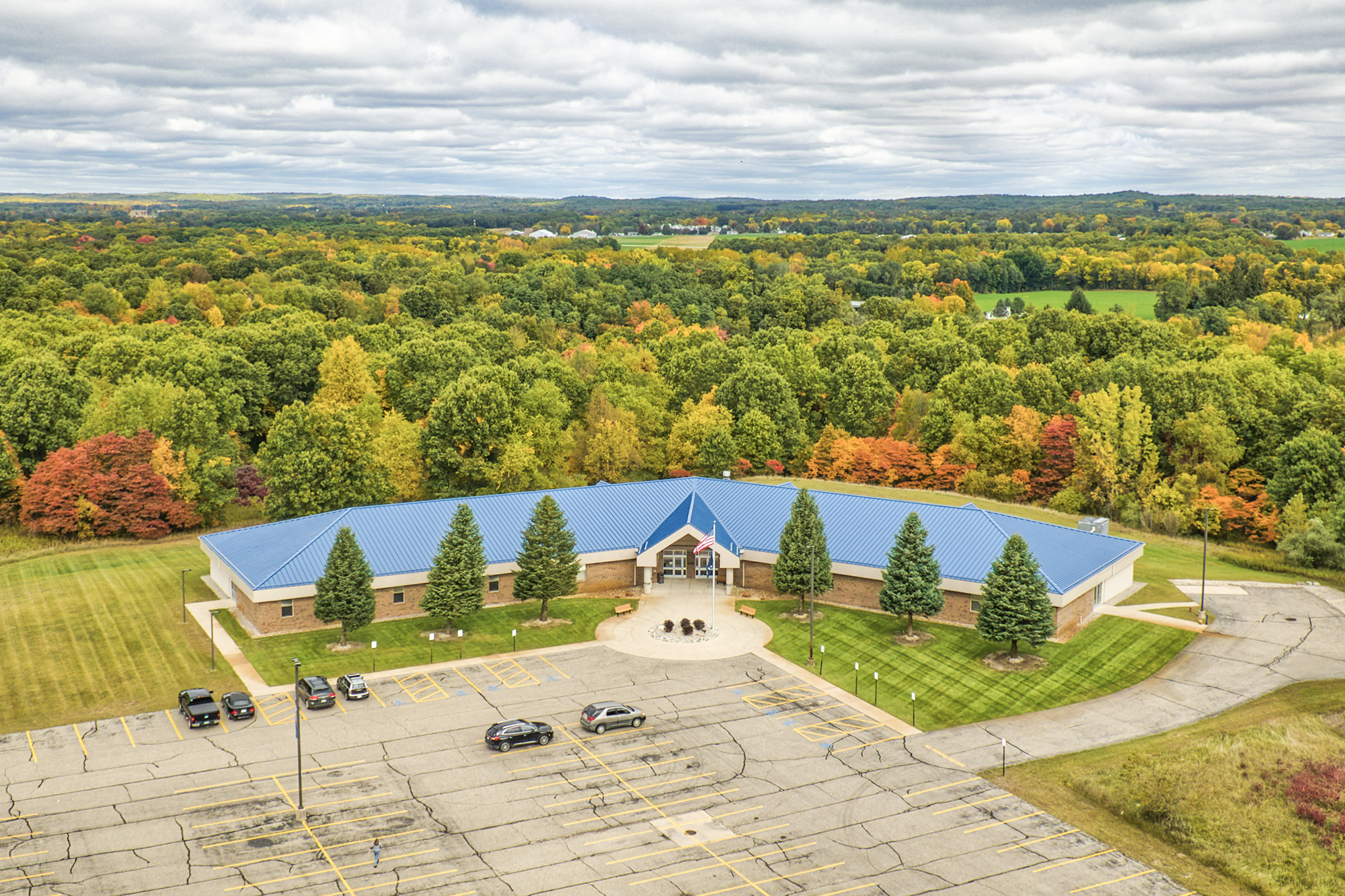
KCC’s C Classroom Building joins a long list of places named for Sojourner Truth. Those interested in learning more can contact the Sojourner Truth Institute of Battle Creek or visit the Sojourner Truth exhibit at the Kimball House Museum downtown.
(Information sources include Tales of Battle Creek by Berenice Bryant Lowe and Sojourner Truth, 1797-1883 by Michael and Dorthy Martich.)
Dr. DeBruler is a historian and professor of History at Kellogg Community College. For more information about History studies at KCC, visit kellogg.edu/history.
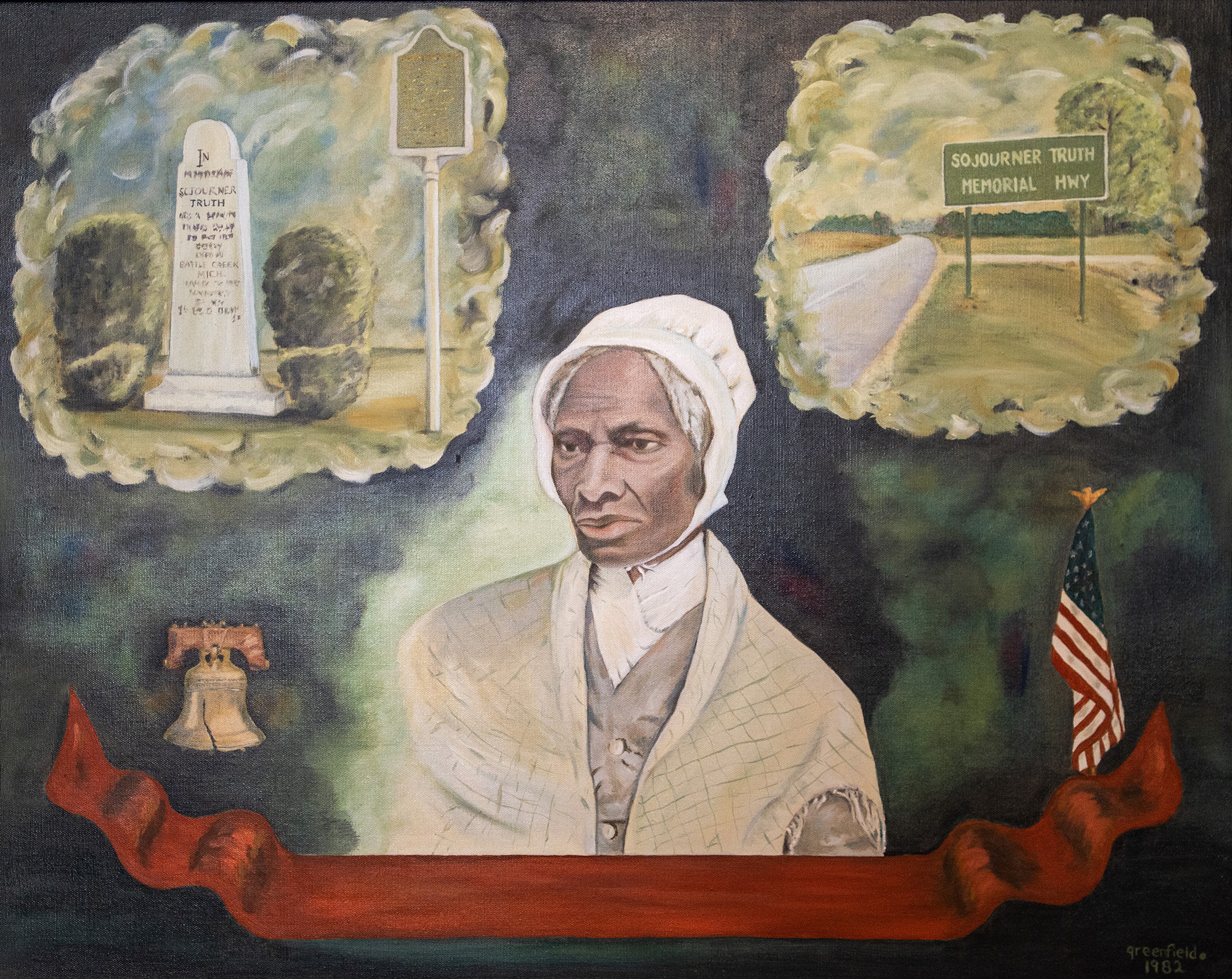
Pictured above is detail from a painting of Sojourner Truth by Pat Greenfield, on display at the Kimball House Museum in downtown Battle Creek.
This article first appeared in the March 2026 edition of BruIN magazine. To read the issue online, please visit kellogg.edu/bruinmagazine.